Guides / Auto Finance
How Much Car Can I Afford? The Complete 2026 Guide by Salary
The average new vehicle sold for $50,562 in September 2026, and Edmunds reports the average new-car loan in Q3 2026 was $44,664 at 7.0% APR over 70.5 months, with a record $787 monthly payment. Another record 21.2% of new-car buyers now commit to payments of $1,000 or more. Meanwhile regular gasoline sits at $4.33 a gallon, $1.27 above last year. This guide uses the 20/4/10 rule and October 2026 loan, insurance, and fuel data to show how much car you can afford at every income level, from $40,000 to $150,000, without wrecking your budget.
Last updated: October 2026
TL;DR - Quick Answer
- The 20/4/10 rule: Put 20% down, finance for 4 years max, keep total car costs (payment + insurance + fuel) under 10% of gross monthly income
- $50K salary: Max car about $4,300 at 7.0% APR ($417/month budget, $82 left for the loan payment)
- $75K salary: Max car about $15,100 ($625/month budget, $290 loan payment)
- $100K salary: Max car about $26,000 ($833/month budget, $498 loan payment)
- Reality check: The $787 average new-car payment (Edmunds, Q3 2026) needs a $94,440 gross income to fit inside 10% before insurance or fuel
- Hidden costs add about $450/month: Insurance (about $200), fuel (about $135 at $4.33/gallon), and maintenance (about $117) sit on top of the loan payment
Sources Edmunds Q3 2026 finance report (Oct 1, 2026), EIA gasoline prices (week of Oct 12, 2026), AAA Your Driving Costs 2026. Checked October 2026.
Use our Auto Loan Calculator and Budget Calculator to model your exact scenario.
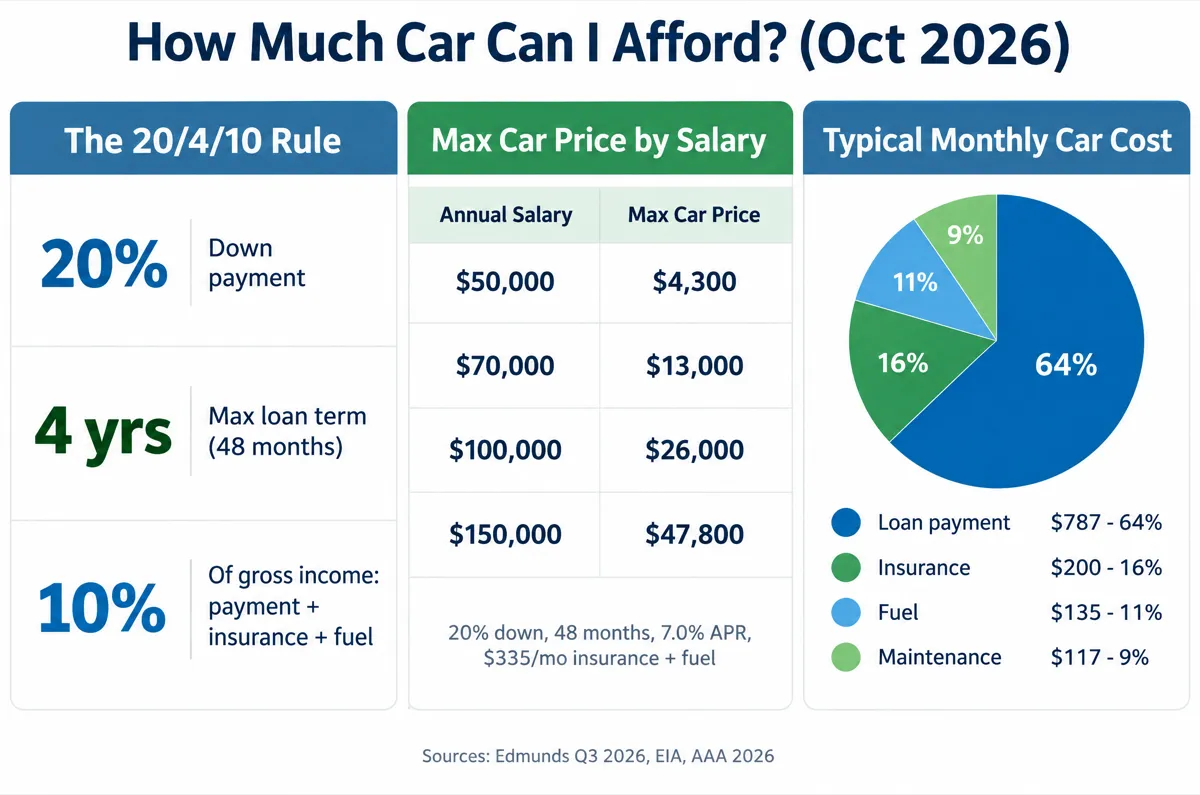
The 20/4/10 Rule: How Much Car You Can Actually Afford
Financial advisors developed the 20/4/10 rule as a guardrail against the auto industry's push toward longer loan terms and lower down payments. Dealerships and lenders will often approve you for far more than you should spend. The 20/4/10 rule draws the line at a sustainable level, and the October 2026 numbers show why it matters: the average new-car buyer finances $44,664 and, over 70.5 months at 7.0% APR, pays $9,938 in interest (Edmunds, Q3 2026).
20% Down Payment
A 20% down payment immediately solves two problems: it reduces your loan balance (and therefore monthly payment and total interest), and it protects you from being "underwater" — owing more than the car is worth. NerdWallet notes that in a normal market cars lose around 20% to 30% of their value in the first year, and AAA's 2026 study puts average depreciation at $4,422 a year. On a $30,000 car, 20% down ($6,000) means you borrow $24,000. If the car is worth $25,500 after you leave the dealership (an illustrative 15% immediate drop), your loan balance is $24,000 — you still have $1,500 of equity. With 0% down, you owe $30,000 on a car worth $25,500, and you are $4,500 underwater from day one. Edmunds reports the average new-car down payment in Q3 2026 was $5,554, only about 11% of the price.
4-Year (48-Month) Maximum Loan Term
The average new-car loan term reached 70.5 months in Q3 2026, and 25.5% of financed new-car purchases now run 84 months or longer (Edmunds). Longer terms lower monthly payments but increase total interest and keep you underwater longer. On a $24,000 loan at 7.0% APR: a 48-month term costs $575/month with $3,586 total interest; a 72-month term costs $409/month but with $5,461 total interest — $1,875 more paid to the bank. If you put $0 down on a $30,000 car, a 72-month loan leaves you underwater for about 15 months and an 84-month loan for about 28 months (peak gap about $1,058), under the depreciation assumptions in the table below. That makes trading in early expensive without rolling negative equity into the next loan.
10% of Gross Monthly Income for Total Car Costs
This is the most commonly violated boundary and the most important. Total car costs for this rule include the monthly loan payment, insurance premium, and fuel; set routine maintenance aside separately. On a $70,000 salary ($5,833/month gross), the 10% ceiling is $583/month. If your loan payment is $480/month, you have just $103 left for insurance and gas — meaning you cannot afford that payment, because full-coverage insurance averages $187/month (Insurify, Sept 2026) to $225/month (Bankrate) and fuel for 12,000 miles at 32 mpg costs about $135/month at today's $4.33 gallon. The 10% rule forces you to account for the real cost of ownership, not just the loan payment.
How Much Car Can I Afford by Salary? (2026 Rates)
The following table applies the 20/4/10 rule at October 2026 rates to show maximum car price by annual salary. For context, Edmunds reports a 7.0% average APR on new-car loans in Q3 2026 (10.6% for used), Experian reports 6.35% new and 11.19% used for Q2 2026, and the Federal Reserve's G.19 release shows commercial banks charging 7.54% on 60-month new-car loans in August 2026. All numbers below assume a 20% down payment, a 48-month loan at 7.0% APR, and $335 a month for insurance ($200) and fuel ($135).
| Annual Salary | 10% Monthly Budget | Max Loan Payment | Max Car Price | Down Payment (20%) |
|---|---|---|---|---|
| $40,000 | $333 | $0 | Cash only | — |
| $50,000 | $417 | $82 | $4,300 | $850 |
| $60,000 | $500 | $165 | $8,600 | $1,720 |
| $70,000 | $583 | $248 | $13,000 | $2,590 |
| $80,000 | $667 | $332 | $17,300 | $3,460 |
| $90,000 | $750 | $415 | $21,700 | $4,330 |
| $100,000 | $833 | $498 | $26,000 | $5,200 |
| $120,000 | $1,000 | $665 | $34,700 | $6,940 |
| $150,000 | $1,250 | $915 | $47,800 | $9,550 |
*Max loan payment = 10% monthly budget minus $335 for insurance ($200, between Insurify's $187 and Bankrate's $225 national full-coverage averages) and fuel ($135 = 12,000 miles at 32 mpg and EIA's $4.33/gallon for Oct 12, 2026). Max car price = max loan (48-month payment at 7.0% APR, the Edmunds Q3 2026 new-car average) / 0.80 to account for 20% down. Actual numbers vary by credit score, location, and vehicle type.
Sources Edmunds, Federal Reserve G.19 via FRED (60-month new-car rate, Aug 2026), Experian Q2 2026. Checked October 2026.
Important Caveat
Below about $55,000 of income, the strict 20/4/10 rule leaves almost nothing for a loan payment once insurance and $4.33 gas are counted. At $40,000 the $333 budget is consumed by insurance and fuel alone. This is by design: at lower income levels a car payment competes directly with rent, groceries, and emergency savings. If you earn under $60,000, prioritize a reliable used vehicle in the $5,000-$12,000 range bought mostly with cash, and avoid financing more than 36 months. Note the contrast with the market: the $787 average new-car payment would need a $94,440 gross income to fit within 10% before insurance or fuel.
Total Cost of Ownership: The Numbers Dealerships Never Show You
Your monthly payment is only 54-70% of the cash a car costs each month in the three examples below. Insurance, fuel, and maintenance add $448-$545 a month, and depreciation adds another $261-$631 that never shows up on a bill. The table uses the September 2026 Kelley Blue Book average transaction price for three of the best-selling segments.
| Monthly Cost | Compact car ($27,977) | Compact SUV ($37,614) | Full-size pickup ($67,573) |
|---|---|---|---|
| Down payment (20%) | $5,595 | $7,523 | $13,515 |
| Loan payment (48 mo., 7.0%) | $536 | $721 | $1,294 |
| Insurance (full coverage) | $200 | $200 | $200 |
| Fuel (12,000 mi/year) | $131 (33 mpg) | $155 (28 mpg) | $228 (19 mpg) |
| Maintenance & repairs | $117 | $117 | $117 |
| Monthly cash cost | $984 | $1,193 | $1,839 |
| Depreciation (11.2% of price/year) | $261 | $351 | $631 |
| Total monthly cost | $1,245 | $1,544 | $2,470 |
| Salary needed (payment + insurance + fuel within 10%) | $104,000 | $129,100 | $206,600 |
*Vehicle prices are the September 2026 Kelley Blue Book average transaction prices for the compact car, compact SUV, and full-size pickup segments. Fuel uses EIA's $4.331/gallon (week of Oct 12, 2026) with assumed fuel economy shown. Insurance is $200, between the $187 Insurify and $225 Bankrate national full-coverage averages; trucks and SUVs often cost more. Maintenance uses AAA's 11.7 cents per mile (about $117 at 12,000 miles). Depreciation applies AAA's 2026 average ($4,422 a year on a $39,376 average MSRP, or 11.2%) to each price.
Sources Kelley Blue Book / Cox Automotive (Oct 13, 2026), AAA Your Driving Costs 2026, EIA, Insurify. Checked October 2026.
The Depreciation Tax
Depreciation is the largest cost of car ownership and the one most buyers ignore because it is invisible — there is no monthly bill. AAA's 2026 study found new vehicles lose a weighted average of $4,422 a year, about $22,100 over five years and 75,000 miles, or roughly 56% of the $39,376 average MSRP. A buyer paying the $50,562 September 2026 average transaction price would lose about $5,660 a year at the same 11.2% rate. Buying a 2-3 year old vehicle lets the first owner absorb the steepest part of that loss, which is why the used-versus-new comparison below favors used on price even though used loan rates are higher.
Case Study: Rachel, 31, Buying Her First Car on a $68,000 Salary
Her Situation
- Age: 31, UX designer in Portland, OR
- Gross salary: $68,000/year ($5,667/month gross)
- Take-home pay: $4,350/month after tax
- Credit score: 720 (prime tier: Experian Q2 2026 average 6.15% new, 8.81% used)
- Savings available for down payment: $7,000
- Current rent: $1,600/month
- Existing debt: $280/month student loan payment
- Needs: reliable commuter, 25-mile round trip, 5 days/week
Her 20/4/10 Budget
- 10% monthly budget: $567/month ($5,667 x 10%)
- Insurance estimate: $165/month (full coverage, Portland rates, clean record)
- Fuel estimate: $87/month (25 mi/day x 22 days, 32 MPG, $5.07/gal West Coast excluding California average, EIA Oct 12, 2026)
- Maintenance reserve: $65/month, kept outside the 10%
- Available for loan payment: $315/month ($567 - $165 - $87)
- Max loan at $315/mo, 48 months, 8.81% (used): $12,700
- Max car price: $15,880 ($12,700 / 0.80, with a $3,180 down payment)
What Rachel Actually Did
The strict 20/4/10 math pointed to a $15,880 max car price. But Rachel had $7,000 saved — far more than the 20% minimum ($3,180) — so she could put a larger down payment to afford a better vehicle. She allocated $6,000 as down payment (keeping $1,000 as a car repair emergency fund) and searched for certified pre-owned vehicles.
She found a 2024 Honda Civic EX with 22,000 miles, certified pre-owned, priced at $22,500. With $6,000 down (27% of price), her loan was $16,500 at 8.81% APR (the Experian Q2 2026 prime-tier used-car average). Over 48 months, her payment was $409/month with $3,138 in total interest.
Rachel's Monthly Breakdown
Loan payment
$409
Insurance
$165
Fuel
$87
Total monthly
$661
Rachel's total monthly car costs came to $661 — 11.7% of her gross monthly income, above the 10% guideline by $94 a month. She accepted this because: (1) her student loan payments end in 14 months, freeing $280/month; (2) the certified pre-owned Civic carries remaining manufacturer coverage, reducing near-term repair risk; (3) the 27% down payment meant she had equity from day one, protecting against negative equity.
The Alternative She Avoided
The dealership approved Rachel for a new compact SUV at $37,614 (the September 2026 segment average) with $2,000 down and 72-month financing at 6.15% APR. That loan of $35,614 would have cost $593/month — more than her entire $567 10% car budget before insurance and fuel. Total monthly costs would have been $845 (14.9% of gross income). After 12 payments she would still owe about $30,550. If the SUV lost 20% of its value in year one it would be worth $30,091, putting her about $460 underwater; at a 30% loss (the top of NerdWallet's normal-market range) she would be about $4,220 underwater. The CPO Civic costs her $184/month less, builds equity faster, and she will own it free and clear in 4 years with roughly 48,000 miles on the odometer (22,000 today plus about 26,400 from her 25-mile commute).
New vs Used: The Real Cost Difference in 2026
New cars offer the latest features, full warranty, and better loan rates. Used cars cost less upfront and avoid the steepest depreciation. The financing gap is real, though: Edmunds reports Q3 2026 averages of 7.0% APR and a $787 payment for new cars versus 10.6% APR and a $582 payment for used cars. Here is the math on the same model bought new versus 2 years old, using Experian's Q2 2026 prime-tier averages (661-780 credit scores) of 6.15% for new and 8.81% for used.
| Metric | New midsize car | Same model, 2 years old |
|---|---|---|
| Purchase price | $30,000 | $22,500 |
| Down payment (20%) | $6,000 | $4,500 |
| Loan amount | $24,000 | $18,000 |
| Interest rate (48 months) | 6.15% APR | 8.81% APR |
| Monthly payment | $565 | $446 |
| Total interest paid | $3,134 | $3,423 |
| Total out-of-pocket (4 years) | $33,134 | $25,923 |
| Out-of-pocket savings (used vs new) | — | $7,211 |
| Extra interest on used | — | $289 |
*APRs are Experian's Q2 2026 averages for prime (661-780) borrowers. The $22,500 used price is an illustrative 25% discount to the new price; check Kelley Blue Book or Edmunds for the model you want. Total out-of-pocket = down payment + 48 monthly payments, before resale value. The $7,211 gap equals the $7,500 price difference minus the $289 of extra interest paid on the used-car loan.
Sources Experian Q2 2026, Edmunds Q3 2026. Checked October 2026.
Step-by-Step: How to Calculate Your Car Budget
Calculate your 10% monthly car budget
Take your gross annual salary, divide by 12, multiply by 0.10. Example: $72,000 / 12 = $6,000/month gross x 0.10 = $600/month total car budget.
Subtract estimated insurance and fuel
Get an insurance quote online (Progressive, Geico, State Farm) before shopping for cars; national full-coverage averages run $187-$225 a month. Fuel for 12,000 miles at 32 mpg and $4.33/gallon is about $135 a month ($108 at 40 mpg, $217 at 20 mpg). $600 - $200 insurance - $135 fuel = $265 available for the loan payment. Set aside about $117 a month for maintenance separately (AAA's 11.7 cents per mile).
Calculate your maximum loan amount
Use the Auto Loan Calculator to find the loan amount that produces your target monthly payment at current rates. At $265/month, 48 months, 7.0% APR, your max loan is approximately $11,070.
Add your down payment to find max purchase price
Max car price = max loan / 0.80 (to build in the 20% down). $11,070 / 0.80 = $13,840 max car price. Your 20% down payment is $2,770, and you finance the remaining $11,070.
Shop within your budget (not the dealer's approval)
Get pre-approved through your bank or credit union before visiting dealerships. Pre-approval locks your rate, prevents dealer markup on financing, and gives you a non-negotiable price ceiling. When a salesperson says "we can get you approved for $45,000," you already know your real number is $13,840.
48 vs 60 vs 72 vs 84 Months: How Loan Term Affects Total Cost
Stretching a loan term lowers monthly payments but increases what you pay in total. With 25.5% of new-car buyers now choosing 84 months or longer (Edmunds, Q3 2026), here is the same $24,000 loan at 7.0% APR across four common terms.
| Metric | 48 Months | 60 Months | 72 Months | 84 Months |
|---|---|---|---|---|
| Monthly payment | $575 | $475 | $409 | $362 |
| Total interest | $3,586 | $4,514 | $5,461 | $6,427 |
| Total paid | $27,586 | $28,514 | $29,461 | $30,427 |
| Car value at payoff | ~$17,400 | ~$15,300 | ~$13,500 | ~$11,800 |
| Equity at month 36 (20% down) | $13,105 | $9,133 | $6,495 | $4,621 |
| Months underwater with $0 down | 0 | 0 | ~15 | ~28 |
| Extra cost vs 48 months | $0 (baseline) | +$928 | +$1,875 | +$2,841 |
*Loan amount: $24,000 at 7.0% APR (the Edmunds Q3 2026 new-car average) on a $30,000 purchase with 20% down. Car values are an illustrative model: 15% depreciation in year 1, then 12% per year thereafter. "Months underwater" applies the same model to a $30,000 loan ($0 down) at each term; underwater means the loan balance exceeds the car's value.
Calculate Your Car Budget
Every situation is different. Use our free calculators to find the exact car price, monthly payment, and total cost that fits your salary, down payment, and loan terms.
Frequently Asked Questions
How much car can I afford on a $50,000 salary?
On a $50,000 salary, the strict 20/4/10 rule leaves very little room for a loan in October 2026. Ten percent of your $4,167 gross monthly income is $417. Full-coverage insurance averages roughly $200 a month (between Insurify's $187 and Bankrate's $225 national averages) and fuel for 12,000 miles at 32 mpg and $4.33 a gallon costs about $135, so only about $82 is left for a payment. At 7.0% APR over 48 months, $82 a month supports a $3,400 loan, or a car of about $4,260 with 20% down. In practice, a $50,000 earner is better off targeting a reliable used car in the $10,000-$15,000 range bought mostly with savings. Stretching to 15% of gross income ($625 a month) lifts the loan payment to about $290, a $12,100 loan, and a car of about $15,100 with 20% down, but that breaks the guideline and should be a deliberate choice.
What is the 20/4/10 rule for buying a car?
The 20/4/10 rule is a car-buying guideline that sets three boundaries: put at least 20% down, finance for no more than 4 years (48 months), and keep monthly transportation costs (loan payment + insurance + fuel) under 10% of your gross monthly income. On a $70,000 salary ($5,833/month gross), that means those three items should stay below $583/month; after about $335 for insurance and fuel, roughly $248 is left for the loan payment. Maintenance is budgeted separately: AAA's 2026 Your Driving Costs study puts maintenance, repairs, and tires at 11.7 cents per mile, about $117 a month at 12,000 miles. The rule exists to stop buyers from becoming 'car poor' and to counter ever-longer loans. Edmunds reports that 25.5% of financed new-car purchases in Q3 2026 carried terms of 84 months or longer, and the average new-car loan ran 70.5 months.
Is it better to buy new or used to maximize affordability?
Used usually wins on total cost, but higher used-car interest rates shrink the advantage. Edmunds' Q3 2026 data shows an average APR of 7.0% for new cars versus 10.6% for used, and Experian's Q2 2026 data for prime borrowers (661-780 scores) shows 6.15% for new versus 8.81% for used. On a $22,000 loan over 48 months, 8.81% costs $4,183 in interest versus $2,873 at 6.15%, which is $1,310 more. That penalty is small next to the sticker gap: in our example a $30,000 new car costs $33,134 out of pocket over 48 months at 20% down, while the same model two years old at $22,500 costs $25,923, a $7,211 saving. Shop used-car rates at a credit union before visiting a dealer, and compare certified pre-owned programs, which sometimes come with lower promotional rates.
How much should I put down on a car to get the best monthly payment?
Aim for 20% down to protect yourself from owing more than the car is worth. On a $28,000 car, 20% down is $5,600, leaving a $22,400 loan. At 7.0% APR (the Edmunds Q3 2026 average for new cars) over 48 months, that payment is $536/month with $3,347 of total interest. With only 10% down ($2,800), the $25,200 loan costs $603/month and $3,765 in interest, which is $67 more per month and $418 more interest. Putting 0% down means a $28,000 loan at $670/month and $4,184 in interest, $134 more per month and $837 more interest than the 20% plan, and some lenders charge a higher rate when you have no equity. For context, Edmunds reports the average new-car down payment in Q3 2026 was $5,554, which works out to about 11% of the vehicle price ($5,554 divided by the $44,664 financed plus the down payment).
Should I buy or lease a car in 2026?
Buy if you drive over 12,000 miles per year, plan to keep the car 5+ years, or want to build equity. Lease if you want a new car every 3 years, drive under 10,000-12,000 miles annually, and prefer lower monthly payments. Take an illustrative $35,000 sedan leased for 36 months at $389/month (an example quote, since lease terms vary widely) plus $3,500 down: $17,504 per lease with no asset at the end. Buying the same car with 20% down ($7,000) at 7.0% APR over 48 months costs $670/month ($32,184 in total payments). Using AAA's 2026 average depreciation rate (about 11.2% of purchase price per year, straight-line), the car is worth about $19,300 after 4 years and $11,500 after 6. Over 6 years, two leases cost $35,008 and leave you with nothing, while buying costs $39,184 in cash outlay but leaves an asset worth about $11,500, a net cost of about $27,700. In this example buying is roughly $7,300 cheaper over 6 years, but leasing is cheaper if you swap cars every 3 years and value the lower monthly payment.
How much do high gas prices change my car budget?
Fuel is the most volatile line in a car budget. The U.S. Energy Information Administration reported regular gasoline at $4.331 per gallon for the week of October 12, 2026, up $1.27 from a year earlier ($3.061). For a driver covering 12,000 miles a year at 30 mpg, that is about $144 a month today versus $102 a year ago, an extra $42 a month. At 20 mpg, a full-size truck costs about $217 a month versus $153. Because fuel counts inside the 10% guideline, every extra $42 a month of fuel reduces your loan payment capacity by the same amount: at 7.0% over 48 months that is about $1,750 of loan, or roughly $2,200 less car price with 20% down. If your commute is long, favor a 35+ mpg car or hybrid before stretching the price.
Related Guides
The 50/30/20 Budget Rule Explained with Real Examples
Learn the 50/30/20 budget rule with real examples at $50K, $75K, and $100K income. Includes a case study, category breakdowns, and when the rule doesn't work.
How to Save $50,000 in 3 Years: A Realistic Plan
A step-by-step plan to save $50,000 in 3 years on an average salary. Includes monthly targets, budget breakdowns, a real case study, and strategies that actually work.
How Much House Can I Afford? Complete Guide by Income Level
Learn exactly how much home you can afford based on your salary, debts, and down payment. Includes income-based tables, a real case study, and the formulas lenders actually use.