Guides / Debt Strategy
Student Loan Repayment: 7 Strategies to Pay Off Debt Faster in 2026
The average federal student loan recipient owes about $40,500. At the 2026-27 undergraduate rate of 6.52%, a $40,000 balance on the 10-year standard plan costs $455 a month and $14,552 in interest. The rules also changed this year: SAVE ended in March, and a new Repayment Assistance Plan (RAP) launched on July 1, 2026. This guide compares seven strategies with exact numbers on a $40,000 balance so you can match one to your income, career path, and goals.
Last updated: October 2026
TL;DR - Quick Answer
- Standard plan baseline: $40,000 at 6.52% costs $455/month for 10 years with $14,552 in total interest
- Fastest payoff: Adding $500/month of side income ($955 total) clears the balance in 4 years and saves $9,039 in interest; $800/month takes 4 years 11 months and saves $7,750
- Lowest cost without extra income: Refinancing to 5.0% over 7 years at $565/month saves $7,062, but only if you give up federal protections
- Lowest monthly payment: RAP at about $150/month on $45,000 of income, with forgiveness after 30 years
- Free money: Employer repayment assistance provides up to $5,250/year tax-free, cutting 4 years 7 months off the standard plan when paired with $300/month of your own
Sources Federal Student Aid, 2026-27 Direct Loan rates (June 4, 2026), StudentAid.gov IDR FAQ (Aug 2026), IRS Section 127 FAQ. Checked October 2026.
Use our Student Loan Calculator and Debt Payoff Calculator to model your exact loan portfolio.
The Student Loan Landscape in 2026
The federal student loan portfolio stood at $1.724 trillion across 42.6 million recipients as of March 31, 2026, which works out to about $40,500 per recipient. The New York Fed counted $1.65 trillion of household student debt in Q2 2026, and 10.6% of that balance was 90 or more days delinquent. Federal Direct Loans first disbursed between July 1, 2026 and June 30, 2027 carry fixed rates of 6.52% for undergraduates, 8.07% for graduate and professional unsubsidized loans, and 9.07% for PLUS loans. Those rates are set by the May 12, 2026 10-year Treasury auction (4.468%) plus a statutory add-on, and each loan keeps its rate for life.
The critical distinction is between federal and private loans. Federal loans offer income-driven repayment, forgiveness programs, and forbearance protections that private loans do not. Before choosing a strategy, categorize your loans: federal Direct Subsidized, federal Direct Unsubsidized, federal PLUS, and private. Log into studentaid.gov to see your complete federal loan portfolio, the disbursement date of each loan, and your current servicer.
All seven strategies below use a benchmark of $40,000 in federal Direct Loans at 6.52%, a single filer with $45,000 of adjusted gross income, and exact month-by-month amortization. The calculations leave out the temporary autopay rate reduction so the comparison stays clean. Your numbers will differ, so run them through our Student Loan Calculator to get precise monthly payments and payoff timelines for your balance and rate.
Sources FSA Portfolio Summary (Mar 31, 2026), NY Fed Household Debt and Credit, Q2 2026 (Aug 11, 2026), Federal Register rate notice (Sept 10, 2026). Checked October 2026.
What Changed in 2026 for Federal Borrowers
Several rules that older repayment advice relies on no longer apply. Check each one against your own loans before picking a strategy.
| Change | What it means for you |
|---|---|
| SAVE plan ended (March 2026) | Servicers began sending 90-day notices on July 1, 2026. Missing the deadline places you in Standard or Tiered Standard. |
| RAP launched (July 1, 2026) | 1-10% of AGI, $10 minimum, interest waiver, up to $50 matching principal, 30-year term. The only IDR plan if all loans are disbursed on or after July 1, 2026. |
| Tiered Standard launched | Term set by balance: under $25,000 is 10 years, $25,000-$49,999 is 15, $50,000-$99,999 is 20, $100,000+ is 25. Applies if you hold a loan first disbursed on or after July 1, 2026. |
| PAYE and ICR sunset | Both end no later than July 1, 2028. IBR remains for loans disbursed before July 1, 2026. |
| Autopay discount raised | 1% rate reduction (up from 0.25%) if you are enrolled in autopay by Dec 31, 2026, in effect through June 30, 2028. |
| Employer help made permanent | Section 127 loan payments stay tax-free at $5,250 per year, indexed to inflation starting in 2027. |
Sources StudentAid.gov SAVE FAQ (Oct 2026), 34 CFR 685.208 (Tiered Standard), IRS IR-2026-55. Checked October 2026.
7 Student Loan Repayment Strategies Compared
Strategy 1: Standard Repayment Plan (Baseline)
The default federal plan assigns fixed monthly payments over 10 years (120 months). On $40,000 at 6.52%, your payment is $455. This is the baseline against which every other strategy is measured.
- Monthly payment: $455
- Payoff timeline: 10 years (120 months)
- Total interest: $14,552
- Total repaid: $54,552
The standard plan is predictable: you know exactly when you will be debt-free, and the payment never changes. The downside is the size of the payment. On a $45,000 salary, take-home pay is roughly $3,195 a month after federal income tax and payroll tax (before state tax), so $455 consumes 14.2% of it. If that ratio strains your budget, consider RAP as a temporary bridge while your income grows.
If you borrowed after July 1, 2026: the 10-year Standard plan is not available once you hold a new loan. The Tiered Standard plan applies instead, and a $40,000 balance falls in the $25,000-$49,999 tier, which means 15 years. The payment drops to $349/month, but total interest rises to $22,799, which is $8,247 more than the 10-year plan.
Strategy 2: Income-Driven Repayment (RAP and IBR)
With SAVE gone, the main income-driven option for most borrowers is the Repayment Assistance Plan. Your monthly payment is a percentage of adjusted gross income (1% to 10% depending on your AGI bracket) divided by 12, reduced by $50 for each dependent on your tax return, with a $10 monthly minimum. Any balance left after 30 years of qualifying payments is forgiven.
| AGI (single, no dependents) | RAP rate | Monthly RAP payment | vs. $455 standard |
|---|---|---|---|
| $30,000 | 2% | $50 | $405 lower |
| $45,000 | 4% | $150 | $305 lower |
| $60,000 | 5% | $250 | $205 lower |
| $75,000 | 7% | $438 | $17 lower |
| $100,000 | 9% | $750 | $295 higher |
On a $40,000 balance, RAP stops being the cheaper monthly option at roughly $78,000 of AGI. Below that, it protects your cash flow. Two RAP features also fix the old problem of balances that grow: if your payment does not cover the monthly interest, the unpaid interest is waived, and if your payment does not reduce principal by at least $50, the Department of Education adds a matching principal payment of up to $50. At $45,000 of income, month one accrues $217 of interest, you pay $150, $67 of interest is waived, and $50 of matching principal pulls the balance from $40,000 to $39,950.
- Monthly payment: $150 in year one, rising as income grows (model assumes 3% annual raises)
- Payoff timeline: about 20 years 6 months (246 months)
- Total interest paid by you: $36,076
- Total repaid: $72,345, plus $2,595 of interest waived and $3,732 of matching principal covered by the government
RAP is a lifeline when income is low, but the cost is time: $17,793 more out of your pocket than the standard plan. Use it strategically. Stay on it while income is below roughly $60,000, then switch to the standard plan or add extra payments once your salary allows. If all of your loans were disbursed before July 1, 2026, IBR is also available (10% of discretionary income with a 20-year term for borrowers whose first loan came after July 1, 2014, otherwise 15% and 25 years). PAYE and ICR end no later than July 1, 2028.
Sources StudentAid.gov IDR FAQ, U.S. Department of Education RAP fact sheet. Checked October 2026. RAP model: single filer, no dependents, AGI of $45,000 growing 3% a year, interest waiver and $50 principal match applied monthly.
Strategy 3: Refinancing to a Lower Rate
Private refinance lenders advertise fixed rates from roughly 3.95% to 11.24% in October 2026, depending on credit score, income, and term. The lowest figures go only to top-credit borrowers who choose short terms and autopay. Refinancing $40,000 from 6.52% to 5.0% over 7 years reduces total interest by $7,062 compared to the standard plan.
- Monthly payment: $565 (7-year term at 5.0%)
- Payoff timeline: 7 years (84 months)
- Total interest: $7,490
- Total repaid: $47,490
- Savings vs. standard: $7,062 in interest, 3 years faster
Refinancing works best with strong credit (720+), stable income above $55,000, and no need for federal protections. The trade-off is permanent: refinancing federal loans into a private loan eliminates RAP, IBR, PSLF, and federal forbearance. Two cautions for 2026. First, federal loans on autopay get a 1% rate reduction through June 30, 2028 (if you enroll by December 31, 2026), so a 6.52% loan effectively costs 5.52% for now and a refinance has to beat that, not 6.52%. Second, refinancing matters most for higher-rate debt such as 8.07% graduate loans and 9.07% PLUS loans. Compare offers from at least three lenders; rate quotes use soft credit pulls that do not affect your score.
Sources Bankrate (updated Oct 13, 2026), Money.com lender rate table (as of Oct 2, 2026). Checked October 2026. The 5.0% rate is an illustrative mid-range offer, not a quote.
Strategy 4: Employer Student Loan Repayment Assistance
Section 127 of the Internal Revenue Code lets employers contribute up to $5,250 per year toward employee student loans tax-free. The One Big Beautiful Bill Act removed the old expiration date (payments after 2025) and, starting in 2027, indexes the $5,250 limit to inflation. The limit is shared with other educational assistance, so $2,000 of loan payments leaves $3,250 for tuition benefits. At $5,250 a year ($437.50 a month), employer assistance covers 96% of the $455 standard payment.
- Employer contribution: $5,250/year ($437.50/month)
- Your additional payment: $300/month in this example ($737.50 total)
- Payoff timeline: 5 years 5 months (65 months); employer money alone takes 10 years 7 months because it falls $17 short of the standard payment
- Total interest: $7,517, saving $7,035 versus the standard plan
Employer assistance is the closest thing to free money in student loan repayment. The $5,250 is excluded from your gross income, so you save on both interest and taxes. If your current employer does not offer it, factor it into job negotiations. A position paying $70,000 with $5,250 a year in loan assistance is worth $75,250 in pre-tax terms, and the assistance is not subject to income tax. Ask your employer to direct payments at your highest-rate loan so they work together with the avalanche method.
Strategy 5: Debt Avalanche (Highest Rate First)
If you have multiple loans at different rates, the avalanche method minimizes total interest. Make minimum payments on all loans, then direct every extra dollar to the loan with the highest interest rate. On a typical three-loan portfolio built from real federal rates of recent years:
| Loan | Balance | Rate | 10-Year Min Payment |
|---|---|---|---|
| Direct PLUS (grad, 2023-24) | $12,000 | 8.05% | $145.91 |
| Direct Unsub (2024-25) | $15,000 | 6.53% | $170.55 |
| Direct Sub (2022-23) | $13,000 | 4.99% | $137.82 |
| Total | $40,000 | 6.49% weighted avg | $454.28 |
Paying only minimums costs $14,514 in interest over 10 years. With $600/month available, pay the $454.28 in minimums and send the extra $145.72 to the 8.05% PLUS loan. It clears in month 49, just over 4 years. Then roll its $145.91 minimum plus the extra to the 6.53% loan, which clears in month 72, and finally the 4.99% loan in month 82. The whole portfolio is gone in 6 years and 10 months with $9,155 in total interest, saving $5,359 compared to minimums. Snowball (smallest balance first) on the same $600 costs $9,310 and takes one month longer, so avalanche saves $155 here. Read our avalanche vs. snowball comparison for more on choosing between the two methods.
Strategy 6: Side Income Acceleration
Adding $500/month of side income on top of the $455 standard payment ($955 total) transforms a 10-year payoff into a 4-year sprint. On $40,000 at 6.52%, this approach saves $9,039 in interest compared to the standard plan. Even a smaller push helps: $800/month finishes in 4 years 11 months and saves $7,750.
- Monthly payment: $955 ($455 standard + $500 side income)
- Payoff timeline: 4 years (48 months)
- Total interest: $5,513
- Total repaid: $45,513
- Savings vs. standard: $9,039 in interest, 6 years faster
Realistic side income sources for recent graduates: freelance work in your field ($30-$75/hour), tutoring undergraduate courses ($25-$50/hour, 20 hours/month), part-time remote work ($20-$35/hour), or gig economy work ($800-$1,200/month). The key is directing every side dollar to loan principal the day it arrives. If it sits in your checking account, it gets absorbed by lifestyle inflation. Set up automatic extra payments through your loan servicer to ensure consistency.
Strategy 7: Public Service Loan Forgiveness (PSLF)
PSLF forgives the remaining balance on federal Direct Loans after 120 qualifying monthly payments (10 years) while working full-time for a qualifying employer: government agencies, 501(c)(3) nonprofits, and certain other public service organizations. RAP, IBR, and the 10-year Standard plan all count as qualifying plans, so a low RAP payment during public service leaves the largest balance to forgive.
- Monthly payment: $150 in year one on RAP at $45,000 income, rising with raises
- Qualifying payments needed: 120 (10 years)
- Estimated amount forgiven: $33,899 of the $40,000 balance (3% annual raises)
- Total out-of-pocket: $23,911 over 120 months
PSLF is the optimal strategy if you plan a long-term public service career. Instead of paying $54,552 over 10 years on the standard plan, you pay $23,911 and the remaining balance is forgiven without federal income tax, a $30,641 difference. The catch is qualifying: you need 120 full, on-time payments under a qualifying plan while employed full-time by an eligible employer. Submit employer certification through the PSLF Help Tool at StudentAid.gov/pslf at least once a year so you know your count long before you apply. The Department of Education finalized a rule that would have let it disqualify employers for a "substantial illegal purpose," but a federal court vacated the employer-eligibility part of that rule on June 30, 2026, so the existing definition of a qualifying employer still applies. Check StudentAid.gov/pslf for updates if litigation continues.
Sources 34 CFR 685.219 (PSLF), NASFAA report on the June 30, 2026 ruling. Checked October 2026.
All 7 Strategies Side by Side
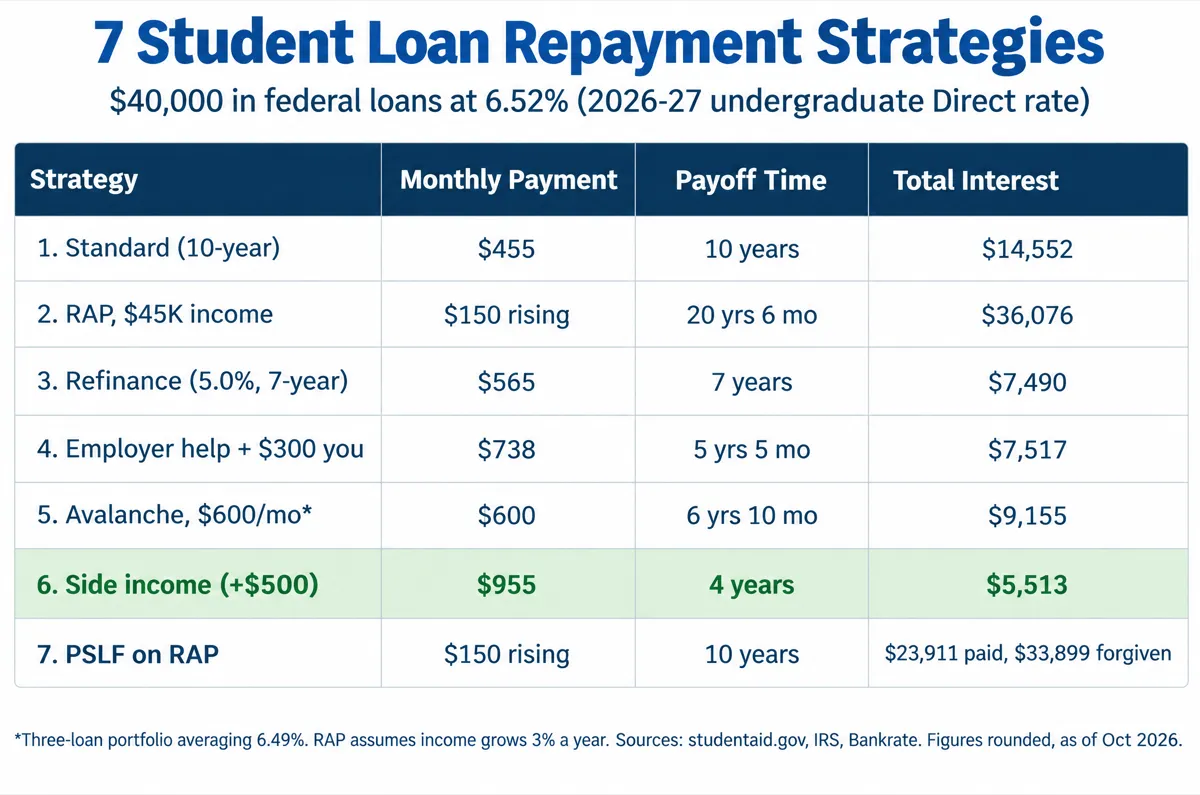
Use this comparison to match a strategy to your income level, career path, and monthly budget. All figures assume $40,000 in federal Direct Loans at 6.52% unless noted.
| Strategy | Monthly Payment | Timeline | Total Interest | Best For |
|---|---|---|---|---|
| Standard (baseline) | $455 | 10 years | $14,552 | Default; predictable |
| RAP ($45K income) | $150 rising | 20 yr 6 mo | $36,076 | Low income; PSLF track |
| Refinancing (5.0%, 7yr) | $565 | 7 years | $7,490 | Good credit; stable income |
| Employer + $300 yours | $738 | 5 yr 5 mo | $7,517 | Employer offers benefit |
| Avalanche ($600/mo)* | $600 | 6 yr 10 mo | $9,155 | Multiple rate loans |
| Side income blast | $955 | 4 years | $5,513 | Fastest debt-free |
| PSLF (RAP + forgiveness) | $150 rising | 10 years | $23,911 paid; $33,899 forgiven | Public service career |
*Avalanche uses the three-loan portfolio above (6.49% weighted average) and compares to $14,514 of interest on minimums. RAP and PSLF rows assume $45,000 of AGI growing 3% a year, a single filer with no dependents. PSLF forgiveness is free of federal income tax. All calculations exclude the temporary 1% autopay rate reduction.
Case Study: Marcus, 26, $45K Salary in Atlanta
His Situation
- Degree: B.S. in Computer Science, state university (graduated 2025)
- Gross salary: $45,000/year (about $3,195/month after federal income and payroll tax)
- Total student debt: $38,500 across 4 federal loans
- Weighted average rate: 5.18%
- 10-year standard payments: $412/month combined
- Rent: $1,100/month (shared apartment)
- Other monthly expenses: $1,200
- Available for extra loan payments: $400/month
His 4 Loans
- Direct Unsub (2024-25): $9,000 at 6.53% ($102/mo min)
- Direct Unsub (2023-24): $10,500 at 5.50% ($114/mo min)
- Direct Sub (2022-23): $9,500 at 4.99% ($101/mo min)
- Direct Sub (2021-22): $9,500 at 3.73% ($95/mo min)
Marcus's Analysis
Marcus ran his options through the Student Loan Calculator. Standard repayment costs $10,936 in interest over 10 years and takes 12.9% of his take-home pay. RAP cuts his payment to $150/month, but his balance takes 18 years and 9 months to clear, with $25,933 in interest. Refinancing was quoted at 6.3% by two lenders for a 7-year loan ($568/month, $9,211 in interest). That is above his 5.18% weighted rate, and the $1,725 it would save versus standard is far less than the $8,300 his employer-assisted plan saves, so he skipped it and kept his federal protections.
His employer, a mid-size tech company, confirmed it offers $5,250/year in student loan assistance under a Section 127 program. Marcus asked his servicer to apply the employer payments to his highest-rate loan (6.53%). Combined with his own $400/month in extra payments directed via avalanche, he projects clearing all four loans in 33 months with $2,636 in total interest, saving $8,300 and more than 7 years versus standard repayment. Without the employer money, his $400 alone would take 53 months and cost $4,285 in interest.
Marcus's Chosen Strategy: Employer Assistance + Avalanche
Marcus combined Strategy 4 and Strategy 5. He keeps paying his $412 of combined minimums, his employer sends $437.50/month, and he adds $400/month, all of the extra money targeting the highest-rate loan first. That is $837.50 of extra principal a month on top of minimums.
| Milestone | Month | Remaining Balance | Interest Paid to Date |
|---|---|---|---|
| Start (Oct 2026) | 0 | $38,500 | $0 |
| 6.53% loan paid off | 10 | $27,411 | $1,405 |
| 5.50% loan paid off | 20 | $15,772 | $2,261 |
| 4.99% loan paid off | 27 | $7,322 | $2,557 |
| All loans paid off | 33 | $0 | $2,636 |
Marcus will be completely debt-free in mid-2029, 33 months after his October 2026 start. Total cost: $41,136 ($38,500 principal + $2,636 interest), versus $49,436 on the standard plan. Starting in month 34, he redirects the $812/month he was paying ($412 of minimums + $400 extra) toward a $15,000 emergency fund and then his Roth IRA. Using our compound interest calculator, $812/month invested at an assumed 7% annual return for 30 years grows to approximately $990,000. That 7% is an illustrative assumption, not a guaranteed return.
Your Step-by-Step Student Loan Payoff Plan
Follow these six steps in order, regardless of which strategy you choose. The first two steps take less than an hour and provide the data you need to make an informed decision.
Inventory every loan with balance, rate, disbursement date, and servicer
Log into studentaid.gov to see all federal loans. Check your credit report for any private loans. Record the exact balance, interest rate, monthly minimum, and current servicer for each. Note whether any loan was disbursed on or after July 1, 2026, because that changes your available plans. If you were on SAVE, find your servicer notice and your plan-selection deadline now. Marcus found all four loans in 15 minutes.
Check if your employer offers repayment assistance
Email HR or check your benefits portal. If the benefit exists but you have not enrolled, sign up immediately. Every month of unclaimed employer payments is $437.50 left on the table.
Run your numbers through the calculator
Enter your exact loan details into our Student Loan Calculator to see standard payment timelines, then test different extra payment amounts. On $40,000 at 6.52%, moving from $455 to $800 per month takes more than 5 years off your payoff date. For RAP and IBR estimates, also use the Repayment Calculator at StudentAid.gov.
Choose your strategy from the comparison table
Match your situation: low income + public sector = RAP with PSLF. Good credit + private sector + no need for federal protections = refinancing. Employer benefit available = employer assistance + avalanche. Want speed above all = side income acceleration. Budget is tight = RAP as a temporary bridge.
Automate payments and specify "apply to principal"
Enroll in autopay by December 31, 2026 to get the 1% federal interest rate reduction through June 30, 2028. On $40,000 at 6.52%, 1 point is roughly $400 in first-year interest. When making extra payments, explicitly instruct your servicer to apply them to principal, not to advance your due date. Without this instruction, servicers may treat the extra as a prepayment of future installments instead of reducing your balance.
Redirect freed payments to investing once debt-free
When your final loan hits $0, immediately redirect the full former payment to an emergency fund (3-6 months of expenses), then to retirement accounts. Marcus's $812/month, invested at an assumed 7% for 30 years, grows to about $990,000. The sooner you are debt-free, the longer your money compounds.
Calculate Your Student Loan Payoff Plan
Enter your exact loan balances, interest rates, and monthly budget to see how each strategy affects your payoff timeline and total interest cost.
Frequently Asked Questions
What is the fastest way to pay off student loans?
The fastest method is sending extra money to principal every month, targeting the highest-rate loan first (the avalanche approach). On a $40,000 balance at 6.52%, raising the payment from $455/month to $800/month cuts the payoff from 10 years to 4 years and 11 months and saves $7,750 in interest. Adding $500/month of side income to the standard payment ($955 total) clears the debt in 4 years and saves $9,039. These figures ignore the temporary 1% autopay rate reduction on federal loans, which would shave a little more off.
Should I refinance my student loans in 2026?
Refinancing makes sense if a private lender can beat your current rate by at least 1 point and you do not need federal protections such as RAP, IBR, or PSLF. In October 2026, refinance lenders advertise fixed rates from about 3.95% to 11.24%, but the lowest rates go only to top-credit borrowers who pick the shortest terms and autopay. On a $40,000 balance, refinancing from 6.52% to 5.0% over 7 years costs $565/month and saves $7,062 in interest. Refinancing federal loans into a private loan is permanent: you lose RAP, PSLF, and federal forbearance. Also remember that federal borrowers who enroll in autopay by December 31, 2026 get a 1% rate reduction through June 30, 2028, which narrows the gap a refinance has to beat.
What is the Repayment Assistance Plan (RAP) and is it a good idea?
RAP is the income-driven plan that became available on July 1, 2026. Your payment is 1% to 10% of adjusted gross income divided by 12, reduced by $50 per dependent, with a $10 monthly minimum, and any balance left after 30 years is forgiven. If your payment does not cover the monthly interest, the unpaid interest is waived, and if your payment does not reduce principal by at least $50, the Department of Education adds a matching principal payment of up to $50. On a $40,000 balance with $45,000 of income growing 3% a year, RAP starts at $150/month but takes about 20 years and 6 months and costs $72,345 in total versus $54,552 on the 10-year standard plan. Use RAP as a bridge during low-income years or as the qualifying plan for PSLF, not as a permanent strategy unless you are pursuing forgiveness.
I was on the SAVE plan. What do I do now?
A court order ended SAVE in March 2026, and servicers began sending SAVE borrowers 90-day notices on July 1, 2026 to choose a new plan. If you miss the deadline and a final 30-day notice, you are placed in the Standard Plan, or the Tiered Standard Plan if you have a loan first disbursed on or after July 1, 2026. Both are fixed-payment plans that can cost more per month than an income-driven plan, so log in to StudentAid.gov, check your deadline, and compare RAP or IBR with the Repayment Calculator before the deadline passes.
How does the avalanche method work for student loans?
List all loans by interest rate from highest to lowest. Make minimum payments on everything, then send all extra money to the highest-rate loan. When that loan is paid off, roll its payment to the next highest-rate loan. On a $40,000 portfolio split into $12,000 at 8.05%, $15,000 at 6.53%, and $13,000 at 4.99%, paying $600/month with avalanche clears everything in 6 years and 10 months with $9,155 in interest. Snowball (smallest balance first) costs $9,310, so avalanche saves only $155 more here. The advantage grows with wider rate spreads, such as a 9.07% Grad PLUS loan next to a 3.73% undergraduate loan.
Does employer student loan repayment assistance really help?
Yes. Under Section 127 of the tax code, employers can pay up to $5,250 per year toward your student loans tax-free. The One Big Beautiful Bill Act made that exclusion permanent and, starting in 2027, indexes the $5,250 limit to inflation. The limit is shared with other educational assistance such as tuition reimbursement. On a $40,000 balance at 6.52%, $437.50/month from an employer plus $300/month from you clears the debt in 5 years and 5 months and saves $7,035 in interest. Employer money alone ($437.50) falls about $17 short of the $455 standard payment, so even a small personal top-up keeps you on schedule. Ask HR whether the benefit exists, because it only works if the employer has a written educational assistance program.
Related Guides
Debt Avalanche vs Snowball Method: Which Gets You Debt-Free Faster?
Compare debt avalanche and snowball methods with a real $38,000 debt portfolio. See which saves more money and which keeps you motivated to finish.
How to Pay Off $10,000 in Credit Card Debt: 5 Proven Strategies
Pay off $10,000 in credit card debt with 5 proven strategies. Compare timelines, total interest, and see which approach fits your situation best.
Compound Interest: 5 Real-Life Examples That Show Its Power
See compound interest in action with 5 real examples: $500/month for 40 years, credit card debt traps, student loans, and the Rule of 72 explained.